The Leadership Challenge
Senior leaders increasingly recognize a difficult reality:
Ethical risk rarely appears as open misconduct. It emerges gradually through tolerated exceptions, inconsistent enforcement, and operational pressures that quietly reshape behavior.
Over time:
standards become interpretive,
escalation slows,
accountability diffuses,
and culture begins to drift despite leadership commitment.
Traditional approaches focus on awareness and communication.
The underlying risk often resides elsewhere — in how the organization is designed to operate under pressure.
Organizational Ethics & Execution Risk Diagnostic
Seattle Consulting Group works with executive teams to examine where organizational design may be unintentionally creating ethical and execution exposure.
This engagement is not training or compliance review.
It is a leadership diagnostic focused on identifying structural conditions that influence behavior across the enterprise.
The diagnostic typically includes:
Executive leadership consultation
Review of accountability and decision structures
Identification of tolerated behavioral signals
Analysis of escalation and consequence pathways
Executive briefing outlining observed risk patterns
The objective is clarity.
Leaders gain a practical understanding of how systems, incentives, and governance mechanisms shape real-world outcomes.
Who This Is For
This work is designed for senior leadership environments, including:
Chief Executive Officers
Chief Human Resources Officers
General Counsel
Executive Leadership Teams
Boards and Governance Committees
Organizations often pursue this engagement when they sense misalignment between stated values and operational reality, or when growth, change, or complexity increases leadership exposure.
The Outcome
Leaders leave with a clearer view of:
where ethical drift may already be forming,
how organizational signals influence behavior,
and which structural adjustments reduce risk while strengthening execution.
Ethical performance becomes less dependent on vigilance and more supported by design.
Begin the Conversation
If your organization suspects that culture initiatives, ethics programs, or leadership expectations are not fully addressing underlying risk, a confidential executive conversation is the appropriate starting point.
About Seattle Consulting Group
Seattle Consulting Group advises organizations on leadership execution, organizational design, and governance effectiveness. Our work focuses on helping leaders build systems that sustain performance, accountability, and trust under real operating conditions.
When Ethics Fails, It Is Rarely a Character Problem
Most organizations invest heavily in ethics programs, leadership training, and culture initiatives.
Policies exist.
Values are communicated.
Training is completed.
Yet ethical failures still occur — often in organizations led by capable, well-intentioned professionals.
The issue is rarely individual integrity.
It is organizational design.
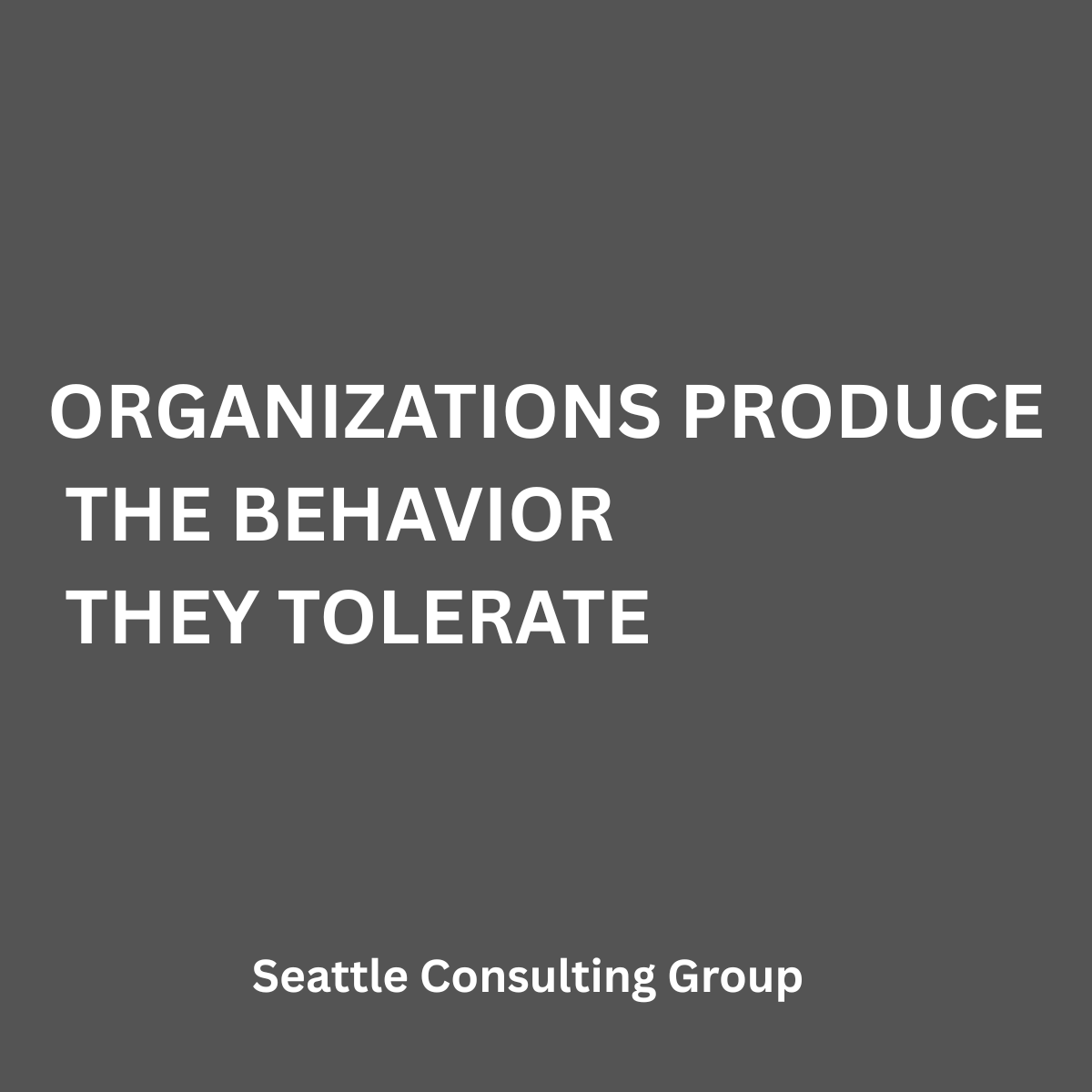
Organizations ultimately produce the behavior they tolerate. When systems allow ambiguity, reward pressure without guardrails, or separate authority from consequence, ethical risk becomes operationally predictable.
Ethics is not sustained by intention alone.
It is sustained by structure.